
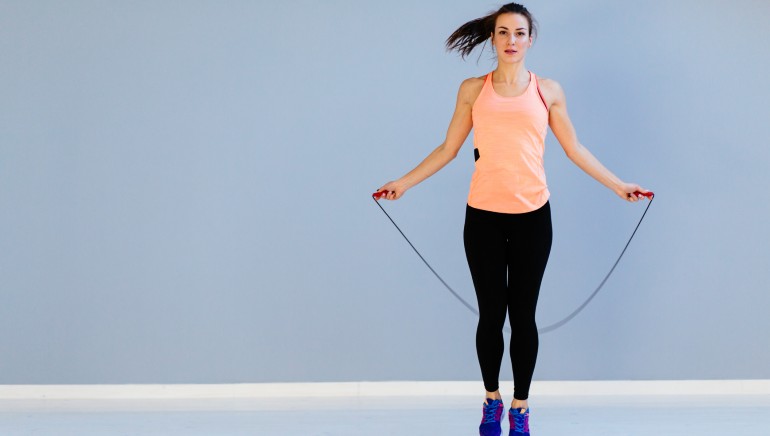
Does Jumping Rope Help Lose Weight?
Contents
Does Jumping Rope Help Lose Weight?
You are doing exercises to lose weight, but you are not sure which exercise will help you give better results. For example, one of the exercises is a jump rope. Does jump rope help lose weight, or it’s only a warm-up exercise? Let’s discuss.
What is Jump Rope?
Jumping rope is a cardio exercise that many athletes, especially boxers, use to build endurance, footwork and coordination.
It works your legs, core, shoulders and arms, and it burns a lot of calories in a short time.
For an average person, it can burn about 10 or more calories a minute, depending on body weight and pace.
Some of the benefits of Rope jumping are-
| 1. | Increase your Lung capacity |
|---|---|
| 2. | Increase Stamina |
| 3. | Burn Calories |
| 4. | Tone your Calves |
| 5. | Tighten your Core |
But jumping rope alone won’t be enough to lose weight. You also need to watch your diet, and mixing in strength training helps.
There are some other weight loss exercises as well. Here are the 15 best bodyweight exercises for weight loss.
However, there are few other things to know before doing jumping rope. Keep reading to know more about jumping rope to lose weight.
Does Jump Rope Help Lose Weight

The first rule of thumb for weight loss is to create a calorie deficit.
A “calorie deficit” means burning more calories than you consume throughout the day.
You can do this by eating less and moving more.
A common rule of thumb is that a deficit of about 500 calories a day (3,500 a week) leads to about 1 pound of weight loss per week. Real results vary because your body adapts as you lose weight.
The number of calories you burn jumping rope depends on your weight and how fast you jump. Harvard Health estimates that a 155-pound person burns about 281 calories in 30 minutes of slow jumping and about 421 calories jumping fast.
A calorie is a measurement of energy, and weight is a measurement of gravity.
When you have more weight, it takes more energy to work against gravity to move your body. That is the reason heavier people burn more calories when working out.
Weight Loss Results Doing Jump Rope
Jump rope weight loss results depend on your-
- Which type of diet do you follow?
- What are your weight loss goals?
- How much do you exercise?
- Level of dedication to the workout.
Some other factors you need to consider are your metabolism and age, impacting how quickly you see results.
Take the example of a 150-pound woman who knows that a 3,500-calorie weekly deficit means about one pound of weight loss.
If she adds 20 minutes of jumping rope 5 days a week, she might burn about 200 extra calories each session. That's an extra 1,000 calories a week, or roughly an additional quarter to third of a pound per week.
Note: The CDC says people who lose about 1 to 2 pounds a week are more likely to keep the weight off. Losing faster can also cost you muscle.
If her diet and exercise together create a deficit for about 1.5 pounds of loss per week, she could lose about 6 pounds a month, or around 12 pounds in 60 days.
As she loses weight, she burns fewer calories doing the same workout, so she will need to jump longer or eat a little less to keep seeing results.
At that pace, losing 20 pounds could take around 3 to 4 months.
Other ConsiderationsRegardingRope Jump
There are other factors to keep in mind when you’re jumping rope for weight loss. For example, doing the same workout yields diminishing results.
You can combine jumping rope with other exercises, such as bodyweight strength moves.
If you start a calorie restriction plan, it's a good idea to tell your doctor about your goals and health history.
Diets like Paleo and Keto are popular, but conditions like heart disease or high cholesterol might mean they aren’t a good option for you.
Jumping Rope Workout for Weight loss
Jumping rope works well as high-intensity interval training (HIIT).
That means short bursts of hard effort followed by rest periods. You will need a stopwatch or a timer app.
Many people share how they transform their body with regular jump rope workouts and a better diet.
A jump rope challenge can be a fun way to stay consistent. Boxers like Mike Tyson made rope work famous.
Here is an example of a jump rope workout-
Step 1: Jump rope for thirty seconds straight; this may be harder than it sounds. Rest for 60 seconds, then repeat. Do this 9 times.
Step 2: Jump rope for thirty seconds straight while alternating feet, Shifting your body weight back and forth, and tightening your core. Rest for 90 seconds between reps. Do this exercise four times.
Step 3: End with a jump rope circuit combination. Do thirty seconds of jumping rope; rest for only 15 seconds before doing thirty seconds of jumping jacks. Rest for 15 seconds, and add in thirty seconds of burpees. Again rest and finish with thirty seconds of pushups.
How to Jump Rope
Invest in a good quality jump rope that is the right length for your height.
If you never do jump rope or if it’s been a while, here is a beginner’s guide:
Stand tall with your feet about hip-width apart and the rope behind your heels. Swing the rope forward using your wrists, not your whole arms.
Jump just high enough for the rope to pass under your feet, and land softly on the balls of your feet.
It takes some practice, but you'll find your rhythm quickly.
Best Jump Rope Exercises
| 1. | Split leg jumps |
|---|---|
| 2. | External-to-Internal Rotation Jumps |
| 3. | Wide-to-Narrow Jumps |
| 4. | Running in Place |
| 5. | Single leg jumps |
| 6. | Rope jumping ladder |
| 7. | Split-leg jumps |
1. Split leg jumps
Start with your right foot forward. As you jump, switch so your left foot lands forward and your right foot back.
2. External-to-Internal Rotation Jumps
Jump and land with your toes turned slightly out, then jump again and land with toes pointing forward. Turn from the hips, not the knees, to protect your knees.
3. Wide-to-Narrow Jumps
Jump your feet out to shoulder-width apart, then jump them back together.
- Running in Place
Alternate between your right and left foot, like jogging. Jump for 60 seconds and build up to 90 seconds. Start with 30-second rests and cut them to 15 seconds as your fitness improves. Complete 4 to 6 sets.
5. Single leg jumps
In this exercise, you jump on one foot. Hop on one foot for 30 seconds, rest for 15 seconds, then switch to the other foot.
- Rope jumping ladder
It is a traditional jump-rope form, taking off and landing on both feet. Start with 30 seconds and then rest for 15 seconds. Do it for 4-6 timed intervals.
7. Split-leg jumps
Start with your right foot forward and switch feet in the air on each jump. Jump for a minute, then rest for thirty seconds. As you improve, jump for 90 seconds and cut rest to 15 seconds. Complete 4 to 6 sets.
Note: The workouts above can be hard for beginners. Start with simple two-foot jumps like the “Rope Jumping Ladder.”
So, does jumping rope help you lose weight? Yes. It burns a lot of calories in a short time, and combined with a calorie-controlled diet it can help you lose weight.
Rope Jump FAQ:
How Long Should I Jump Rope to Lose Fat?
Beginners can start with short intervals: jump for 30 seconds, rest for 60 seconds, and repeat for 5 to 10 minutes. As you get fitter, jump longer, rest less, and work up to 15 to 20 minutes most days, alongside a calorie-controlled diet.
Can I Lose Weight by Jumping Rope Every Single Day?
Yes, if it helps you burn more calories than you eat. Harvard Health estimates a 155-pound person burns about 280 to 420 calories in 30 minutes, depending on pace. Heavier people burn more. Give your calves and joints rest days if they get sore.
What Happens If You Skip Rope Every Single Day?
You burn a lot of calories and build endurance. Fast jumping burns roughly 680 to 1,000 calories an hour depending on body weight, compared with about 210 to 320 for brisk walking. Jumping is high impact, so build up gradually to avoid shin and calf injuries.
Are weighted jump ropes good?
Yes. Speed ropes and weighted ropes both improve coordination, footwork, agility and endurance. A weighted rope also works your arms and shoulders more and can raise the effort, but your total calorie burn depends mostly on how long and how hard you jump.
Sources
- Calories burned in 30 minutes of leisure and routine activities, Harvard Health
- Steps for Losing Weight, CDC